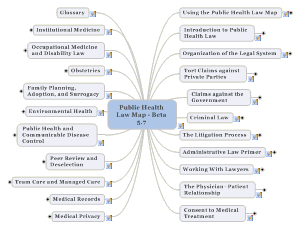
The Public Health Law Map is an ongoing project to bring public health law
information to public health practitioners, their lawyers, and students of public
health, and the general public. It is being done as an online resource so that it
can be updated and to make as widely available as possible. It is not a
substitute for legal advice, and since state law varies, it is not a specific guide
for any state. For information on how to use the Map, see:
As the Public Health Law Map evolves, the URLS for some pages may change,
but every effort will be made to keep them static so that links will be good
through time. Since there will be many changes while the Map is in the Beta
stage, please link only to the home page:
Once the development period is over, links to subtopic pages should be stable.
Edward P. Richards
Director, The Climate Change and Public Health Law Site
Harvey A. Peltier Professor of Law
Louisiana State University Law Center
richards@lsu.edu
For more information, see: